The Republic of Moldova stagnates in the ILGA-Europe Rainbow Map 2026 ranking: 25th place out of 49 countries, with the same score of 38%.
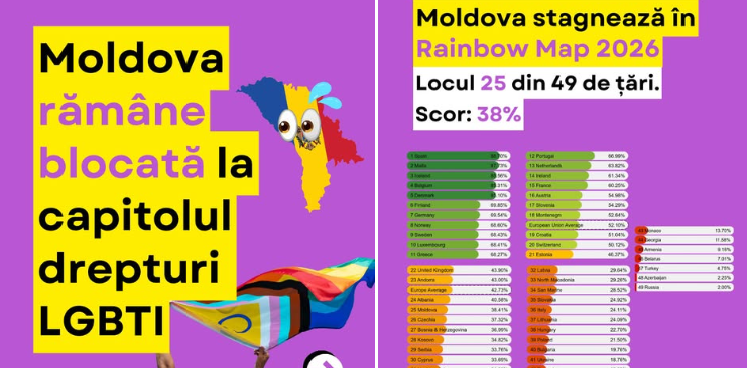
The Republic of Moldova remains in 25th place out of 49 countries in the 2026 edition of #RainbowMap, ILGA-Europe’s annual ranking of legislation and public policies affecting LGBTI people. Our country retains last year’s score of 38%, indicating stagnation in legal protection for LGBTI people.
According to ILGA-Europe, the Republic of Moldova has made no legislative progress since the 2022 amendments to the Law on Ensuring Equality. Those amendments explicitly included sexual orientation and gender identity among the protected grounds and strengthened legislation on bias-motivated crimes.
Since then, however, the authorities have taken no meaningful steps to expand legal protection for LGBTI people. Moldova still lacks legal recognition for same-sex couples, clear and accessible procedures for legal gender recognition, coherent public policies to protect trans and intersex people, and adequate mechanisms to prevent and penalise hate speech.
This year’s Rainbow Map also notes that, although the 2025 Moldova Pride March took place, the Chișinău Municipal Council attempted to ban it. This highlights the tension between legally guaranteed rights and local political resistance to the visibility of the LGBTI community.
At the European level, the 2026 Rainbow Map marks a significant change: Spain takes first place for the first time, replacing Malta, which led the ranking for ten years. ILGA-Europe attributes Spain’s rise to a package of legislative and institutional measures, including the depathologisation of trans identities within the healthcare system, new national strategies for LGBTI and trans people, an independent authority for equal treatment and non-discrimination, and political resistance to far-right attempts to dismantle existing protections.
At the same time, ILGA-Europe warns that legal progress does not automatically translate into safety in everyday life. Even in Spain, which has Europe’s most advanced legal framework, attacks against LGBTI people have increased by 15% compared with 2024, amid a climate of hate speech.
“This year’s ranking tells two stories at once: one of political courage and real progress, and another of growing dangers for LGBTI communities across Europe,” said Katrin Hugendubel, Deputy Director of ILGA-Europe.
Several European countries have seen worrying developments: Belarus has adopted an anti-LGBTI law inspired by the Russian model; Slovakia is seeking to block legal gender recognition through constitutional amendments; Portugal is debating proposals that would weaken protections for trans and intersex people; and Russia remains at the bottom of the ranking, with LGBTI organisations labelled “extremist”.
Against this regional backdrop, Moldova’s stagnation cannot be treated as merely an absence of progress. Legislative and political inaction leaves LGBTI people exposed to discrimination, hate speech and attacks on freedom of assembly.
The GENDERDOC-M Information Centre reiterates that the Republic of Moldova must move beyond minimal reforms towards coherent public policies grounded in equality, dignity and safety for all citizens.
 15.10.2026
Human Rights
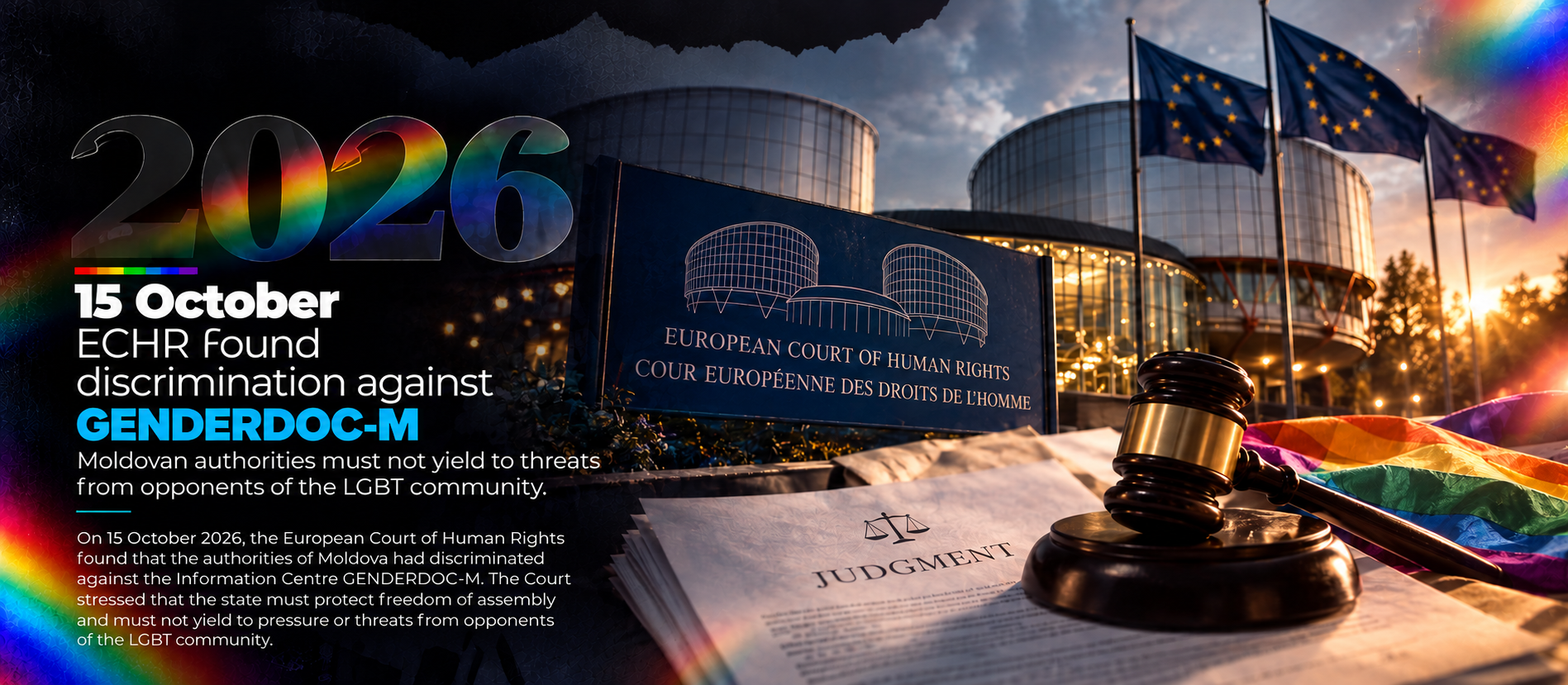
ECHR finds discrimination against the GENDERDOC-M Information Centre: Moldovan authorities must not give in to threats from opponents of the LGBT community
15.10.2026
Human Rights
ECHR finds discrimination against the GENDERDOC-M Information Centre: Moldovan authorities must not give in to threats from opponents of the LGBT community

 22.05.2026
Human Rights
Schumacher's brother marries a Frenchman: The wedding will take place in Saint-Tropez
22.05.2026
Human Rights
Schumacher's brother marries a Frenchman: The wedding will take place in Saint-Tropez
 24.04.2026
Human Rights
Man convicted of domestic violence against transgender minor. Court upholds gender identity-based prejudice
24.04.2026
Human Rights
Man convicted of domestic violence against transgender minor. Court upholds gender identity-based prejudice