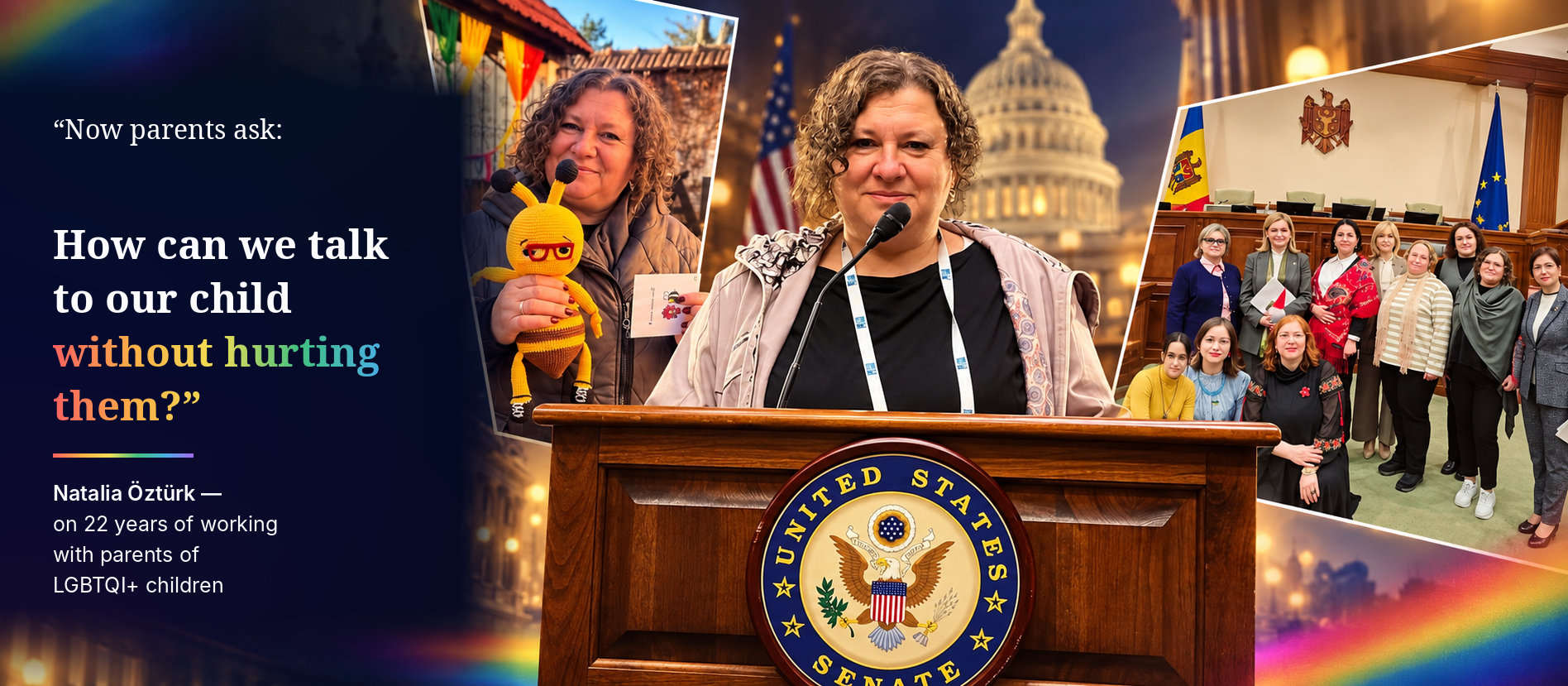
“Parents now ask: how can I talk to my child without hurting them?” Natalia Ozturk on 22 Years of Working with Parents of LGBTQI+ Children
More than two decades ago, when a young gay man or lesbian in the Republic of Moldova came out to their family, their parents might respond with rejection, attempts to “change” them, silence, or fear that relatives and neighbours would find out. Mothers were often the first to learn about their children’s sexual orientation. They were also the ones left to deal with that knowledge alone, keeping it even from their children’s fathers.
It was out of situations like these that Bee Parents, a support group for parents of LGBTQI+ children, coordinated by Natalia Ozturk, emerged. The group has existed for around 22 years, although the name Bee Parents came much later. Over that time, both parents’ attitudes and the age at which children come out have changed. While many young people once waited until they were financially independent before coming out, Natalia now meets parents of children aged 11 to 13. Some parents even seek professional guidance before their child has told them anything, asking how to start a conversation without causing hurt.
We spoke with Natalia Ozturk about how the support group for parents of LGBTQI+ children began, what happens in a family after a child comes out, and how parents in the Republic of Moldova have changed over the past two decades.
Natalia, how did the support group for parents of LGBTQI+ children begin?
It all happened very naturally. As people in the community became more open and started telling their parents about their sexual orientation, I would get calls: “Mum found out. Please come.”
I would go over and talk to their mother. I tried to explain what sexual orientation is, what her child was going through and, most importantly, that this was still the same child she had always known.
At first there was one mother, then two, then three. Together with the psychologist working at GENDERDOC-M at the time, we thought it would be more helpful to bring them together. That was how the support group now known as Bee Parents began. We explained sexual orientation, gender identity and coming out, and the stages a parent might go through after learning about their child’s identity.
I remember that, during the first meetings, the children waited downstairs for their parents. They were very anxious about what was happening upstairs in the group.
Why can a child’s coming out be so difficult for a parent?
Because parents start imagining their child’s future very early on: how they will grow up, whom they will marry, what kind of family they will have, perhaps even what their grandchildren will look like. When their child says they are gay, lesbian, bisexual or transgender, that imagined future can collapse in a second.
A parent may also already have very negative ideas about homosexuality or transgender people. Suddenly, all those stereotypes overshadow their own child.
One approach I use is to ask the parent: “What makes you proud of your child?” They start telling me: my child is kind, responsible, did well at school, helps me, has a career. Gradually, the parent starts seeing their child as a whole person again, rather than seeing only their sexual orientation.
How did you learn to have these conversations at a time when homosexuality was rarely discussed in the Republic of Moldova?
I supported my best friend and my cousin through coming out. That was in the 1990s. My friend was going through a very difficult time, including depression, and was afraid of what would happen to his life and career.
I accompanied him to appointments with a psychiatrist and a sexologist. It mattered a great deal to me that the doctors told us homosexuality was not, in itself, a problem. The psychiatrist treated his depression, not his sexual orientation. That helped me understand a great deal, too.
Later, when other young people started calling me after coming out, I already had that experience.
Why did the group initially consist mainly of mothers?
Because children usually told their mothers first. The mothers would then keep that information from the fathers. Sometimes they were afraid the father would hit the child or throw them out of the house.
The mother was caught in the middle. She needed to protect her child while hiding something very important from her husband, relatives and colleagues. She would start lying, making up explanations and avoiding certain conversations. She was left alone with everything she was feeling.
The support group was one of the few places where she could speak openly about what was happening in her family.
Have fathers’ attitudes towards their LGBTQI+ children changed over that time?
Yes. Fathers are much more open and involved now. They want to understand what their child is going through, and they look for answers.
But I have noticed that fathers and mothers may need different approaches. Mothers often need to talk at length, revisit the same feelings and listen to other mothers’ stories. Fathers more often ask specific questions and look for very clear answers.
What matters is that we now see them taking part in this process, too. Twenty years ago, that happened much less often.
Do parents always learn that their child is LGBTQI+ directly from the child?
No. There is coming out, and there is outing. Outing is when someone else discloses a person’s sexual orientation or gender identity without their consent. A parent might find out at school, or from neighbours or relatives. They might also discover messages on a phone or computer. These situations are even more difficult because the child is not ready for the conversation either.
You say a new group of parents has emerged in recent years. What has changed?
I have noticed this particularly over the past five or six years. Parents notice something, begin to wonder, and approach a psychologist, GENDERDOC-M or me on their own initiative. Their question is: “How can I talk to my child without hurting them?” Sometimes the child has not told them anything yet. The parent searches online, tries to understand what is happening and wants to know how to begin that conversation. For me, this is one of the most important changes I have seen.
How do you explain this shift in parents’ attitudes?
I think relationships between parents and children have changed in general. Today’s parents are more attentive to their children’s emotions than previous generations were.
I also think the work GENDERDOC-M and the community have done over all these years has made a difference. Of course, hate speech and widespread homophobia are still with us. But twenty years ago, the question might have been: “How can I change my child?” Today, I am much more likely to hear: “How should I behave towards them?” or “How should I talk to them?” More and more parents understand that sexual orientation is not something that needs to be “changed”.
Has the age at which children tell their parents about their sexual orientation changed?
Very much so. At first, there were no parents of teenagers in our group. Many young people waited until they were in their twenties, had a job and were financially independent before telling their parents. The fear was overwhelming: if they throw me out, what will I do?
Now we have parents of children aged 11, 12 and 13. As children reach puberty and experience their first crushes, they begin to understand whom they are attracted to, and some decide to talk about it at home.
Can an 11- or 12-year-old already know that they are gay or lesbian?
A child that age can know whom they fall in love with and whom they are attracted to. As adults, we sometimes forget how young we were when we first fell in love ourselves. The difference is that children today have more opportunities to talk about their feelings. They can speak to their parents, see a psychologist or find information. I hope that will help them grow into more emotionally healthy adults.
What actually happens at Bee Parents support group meetings?
In the early years, there were a lot of tears. Parents would come, tell their stories, try to understand and change their attitudes. Then they would leave the group and return to a society where they would once again hear insults and comments about their own children. It was very hard. Over time, we tried different approaches, and now much of our work takes the form of group psychotherapy. It is a confidential, safe space. Very often, we go far beyond the subject of a child’s sexual orientation. Parents begin talking about their own trauma, their relationships with their parents, experiences of abandonment, and things they have carried with them for decades.
I have seen women in their seventies begin working through very old emotional wounds. When a parent begins to understand themselves better, their relationship with their child changes, and sometimes their relationships with the whole family do, too.
You have also encountered some very harsh parental reactions. Is there a case that particularly affected you?
I remember one mother whose son was already around forty. She worked in Italy and had invested so much in him: in his education, his home, his future. He was successful professionally, worked on international projects and spoke several languages. When he told her he was gay, she asked: “Why didn’t you kill yourself?” Hearing that from your own mother is devastating, even when you are forty.
Later, this woman came to the group. She met other gay men, spoke to a mother who had accepted her son, and began a very long journey. As far as I know, their relationship has stabilised, but they still avoid the subject of his sexual orientation. Acceptance does not always come quickly, and it does not always reach the level we would hope for.
Why do some parents say such cruel things to their children?
Sometimes it is the shock speaking. Sometimes it is fear of society: what will relatives, neighbours, people in the village or colleagues say? For some parents, the family’s reputation and other people’s opinions carry enormous weight. But parents also have emotional wounds of their own. That does not mean we should excuse words that can deeply hurt a child. It means that, if we want to work with that parent, we need to understand where the reaction comes from and what lies behind it.
What would you say to parents who insist they would never accept their child if they found out they were gay, lesbian or transgender?
First, I would tell them that they are not to blame for their child’s sexual orientation or gender identity. And the child is absolutely not to blame either.
Remember that this is your child, and that they are probably already dealing with a great deal internally. If they have chosen to tell you themselves, that means they trust you deeply. It means they feel able to be open enough with you to share something so important.
There is something else I want to tell parents: do not put other people’s opinions above your own child. What will people in the village say? If they care about you, they will still care about you. If they do not, they will find other reasons to judge you anyway.
Your child is the person closest to you. Do not put society’s opinion above them.
Why do you think being “like everyone else” matters more to many parents than having a good relationship with their own child?
Because they are afraid of being left alone, of becoming isolated. For some parents, the possibility of rejection by society carries enormous weight. They grew up with this need to be accepted by others. But losing their relationship with their own child also means isolation. And that can be far more painful.
Some parents carry trauma of their own and have spent their whole lives trying to earn acceptance and live up to other people’s expectations. That is why it can sometimes be so difficult for them to change the way they see things.
After more than twenty years of working with parents, do you believe we can change these attitudes?
Yes. We are making a difference, and things are changing. I see parents who have changed their attitudes, and I am glad to have played even a small part in that. I see happier children who are more confident in themselves. I see children whose parents no longer hit them, thank goodness.
I belong to a generation for whom beatings were commonplace. We knew what it meant to be beaten by our parents. Today, when I talk to young people about this, some cannot even imagine it. To them, the very idea that a parent could hit their child is absurd. That shows that things are changing. Perhaps not as quickly as we would like, but I see changes in the families I work with. I see parents who understand their children better, and children growing up with greater self-confidence.
Source: nordnews.md
Author: Eugenia Ciubrei