- Home Page
-
Organization’s history
1995
1998
1999
2000
2001
1995
Decriminalization of Consensual Homosexual Relations Between Adults
Decriminalization of Consensual Homosexual Relations Between Adults
When speaking about the infamous criminal provision, Article 106 “Sodomy,” under which voluntary “sexual intercourse between a man and another man” was punishable by imprisonment for up to three years, various sources state that it was repealed in 1995. However, this is not entirely accurate. Within the framework of a broader legislative reform, the article did not disappear but was substantially revised.
As of June 15, 1995, it received a new title — “Article 106. Forced Sodomy.” In its revised version, the article referred to “sodomy committed against a minor, or through the use of physical or psychological violence, or by exploiting the victim’s helpless condition,” for which a penalty of two to five years of imprisonment was предусмотрed.
Thus, the article was retained, but its meaning was fundamentally changed: from 1995 onward, Moldova effectively ceased criminal prosecution for consensual homosexual relations between adults, even though the term “sodomy” formally remained in the criminal legislation.
In this form, the article existed until the adoption of the new edition of the Criminal Code — No. 985-XV of April 18, 2002. In the updated Criminal Code, Article 106 already concerned “forced confiscation of property,” while sexual offenses were consolidated into six articles of Chapter IV:
171 — “Rape”;
172 — “Violent acts of a sexual nature”;
173 — “Sexual harassment”;
174 — “Sexual intercourse with a person under the age of 16”;
175 — “Lewd acts”;
175-1 — “Grooming a minor for sexual purposes.”
From that moment on, the concept of “sodomy” completely disappeared from the legislation of the Republic of Moldova — and, in essence, from public life.
Life in the Shadows
Article 106 meant that, during the Soviet era, gay men were forced to live in fear, hiding their identity from society. Sexual relations between men were punishable under criminal law. The author of this article is unaware of whether anyone in the Moldavian SSR was ever convicted under this provision. Nevertheless, the fear of possible prosecution followed homosexual men throughout their lives.
And yet, gay men continued to live and love, albeit in an atmosphere of secrecy. They met in certain places that were kept discreet. Some of these locations — such as A. S. Pushkin Park, the public toilets at Komsomol Lake, bus and railway stations, as well as a place in the Botanica district known as “by the airplane” — were well known within the community.
There, among their own, gay men could be themselves: they socialized, met new people, and began relationships. There were also apartments where groups of gay friends would gather. They often spent time together, going to the cinema, concerts, and theatre performances, and celebrating birthdays and other occasions. Occasionally, two men would live together as a couple, although this was rare. As a rule, such living arrangements raised many questions among neighbours and sometimes even provoked hostility.
In addition to the militia, gay men also had to beware of the so-called “remontniki” — aggressive homophobes who would arrange meetings with gay men while pretending to be interested in a relationship, only to assault or blackmail them afterwards. At the same time, gay men were often capable of defending themselves.
However, in cases of assault or blackmail, they were afraid to turn to law enforcement. In practice, militia officers often sided with the “remontniki,” leaving gay men trapped in a situation with little or no protection. Law-enforcement officials could — and often did — inform employers that one of their employees was known to frequent “gay” meeting places. After that, the person concerned would begin to face problems at work.
1998
Registration of the GenderDoc-M Information Center and the Journal “Zerkalo”
Breaking the silence: first media reactions
Registration of the GenderDoc-M Information Center and the Journal “Zerkalo”
On May 8, 1998, the GENDERDOC-M Information Center was registered as a non-governmental organization without a membership structure. The founders were: Alexei Marchkov (Chairman and Director of the Center), Sofia Marchkova, Nadezhda Mityeva, and Ivan Zverev (auditor). Accounting was handled on a voluntary basis by Elena Mityeva.
In October 1998, the first issue of the journal Zerkalo (“Mirror”) was published, as indicated on the cover page. The print run was not specified; however, this issue became the largest in the journal’s entire history — 2,500 copies. At that time, the journal had not yet been officially registered.
On November 6, 1998, Zerkalo was registered as the company “Zerkalo” LLC. Alexei Marchkov became Editor-in-Chief and Director, and Elena Mityeva served as Accountant.
Breaking the Silence: The First Media Responses
The first issue of the journal published an “Appeal to the Public of the Republic, to the Gays and Lesbians of Moldova.” This text became the catalyst for numerous media reactions — a genuine breakthrough in overcoming the silence that had surrounded the topic of homosexuality in the country.
At the end of 1998, Arguments and Facts — Moldova published an interview with Alexei Marchkov, Director of the GenderDoc-M Information Center (“The Law Tolerates, but the Crowd Beats,” No. 50 (133), December 1998). The newspaper Yunost wrote about gender-related work in the article “We Believe, We Hope, We Wait” (No. 12, October 23, 1998). The publication of the first issue of the journal was noted by Novoe Vremya (“In ‘Zerkalo,’ Gays Saw Only Themselves,” No. 3, December 25, 1998). These publications were benevolent in tone, demonstrating understanding and professional integrity.
However, openly xenophobic reactions also emerged. The newspapers Flux and Communist responded harshly, publishing respective commentaries: the article by St. Stoian “The Wave of Homosexuality Has Reached Chișinău” and a piece by K. Voloshin titled “Either One of Them, or Money Has No Smell,” published in the column “Free Press of the Regime.”
The authors of such materials portrayed LGBT people as a “social threat,” asserting that “homosexuality” leads to societal degradation and the destruction of the family. Their logic ultimately suggested that the only way to “save society” was to isolate homosexuals, including placing them in psychiatric institutions.
In the second issue of Zerkalo (already officially registered), published in early 1999, Vlad Negru, Co-Chair of the Senate of the “Curcubeu/Raduga” (“Rainbow”) Movement, rightly observed:
“It is unclear what fuels the homophobic impulses of moralists from both the far right and the far left… Of course, it would be easier for them to live if all those who do not meet their standards were locked away in special clinics — but how would they explain, for example, to a familiar child why that seemingly ordinary man over there is being dragged into a vehicle by orderlies?.. Doesn’t this remind you of anything?”
In essence, the article published in the same issue, “Fortunately, Not Everyone Picked Up a Stone,” became the first political statement of the Public Movement “Curcubeu/Raduga.” It “awakened” the community and provided a powerful impetus for new publications in the press, on radio, and on television.
Breaking the silence: first media reactions
The first issue of the magazine published the “Appeal to the Public Opinion of the Republic, to the Gays and Lesbians of Moldova”. This text generated numerous reactions in the mass media – a real breakthrough in breaking the blockade of silence surrounding the topic of homosexuality in the country.
At the end of 1998, “Argumentî i Faktî — Moldova” published an interview with Alexei Marchkov, director of the “GENDERDOC-M” Information Center (“The Law Tolerates, but the Crowd Strikes”, No. 50 (133), December 1998). The newspaper “Iunoști” also reported on gender activity (“We Believe, We Hope, We Wait”, No. 12 of October 23, 1998). The publication of the first issue of the magazine was mentioned by the newspaper “Novoe Vremea” (“In “Zerkalo” gays saw only themselves”, No. 3 of December 25, 1998). These publications had a benevolent tone, demonstrating understanding and professionalism.
However, there was no lack of openly xenophobic reactions. The newspapers “Flux” and “Communism” reacted harshly, publishing corresponding materials: the article by St. Stoian “The wave of homosexuality has reached Chisinau” and K. Voloșin’s reply “Either it’s theirs, or the money doesn’t smell”, in the column “The regime’s free press”.
The authors of these materials presented LGBT people as a “social threat”, claiming that “homosexuality” would lead to the degradation of society and the destruction of the family. Their logic boiled down to the idea that the only way to “save society” would be to isolate homosexuals, including their internment in psychiatric institutions.
In the second issue of the magazine “Zerkalo” (already registered), published in early 1999, the co-chairman of the Senate of the “Curcubeu/Raduga” Movement, Vlad Negru, rightly remarked:
“It is not known what exactly fuels the homophobic impulses of the extreme right and extreme left moralists… Of course, it would be easier for them to live if all those who do not meet their standards were locked up in special clinics – but how will they explain, for example, to a child they know, why that uncle, perfectly normal at first glance, is being dragged by paramedics into a car?.. Doesn’t this remind you of nothing?”
In essence, the article published in the same issue, “Fortunately, not all of them lifted the stone”, became the first political statement of the “Curcubeu/Raduga” Public Movement. It “awakened” the community and provided a strong impetus for new publications in the press, on radio and television.
1999
Founding Conference of the “Curcubeu/Raduga” Movement
The first project of the “GenderDoc-M” Information Center
Founding Conference of the “Curcubeu/Raduga” Movement
On January 17, 1999, a meeting of representatives of the LGBT community (attended only by gay men) took place in Chișinău and evolved into the founding conference of the Public Movement of Gays and Lesbians of Moldova “Curcubeu” (“Rainbow”). The conference elected its governing body — the Senate — headed by Chairman Alexei Marchkov, as well as three Co-Chairs representing the interests of different groups (gay men, lesbians, bisexuals), and two senators — a responsible secretary and a legal advisor. The position of Co-Chair representing lesbians remained vacant, as at that time the organizers of the Center and the Movement had no established contacts with lesbians.
The First Project of the GenderDoc-M Information Center
The first project implemented by the Center was titled “Human Rights and Sexual Minorities in Moldova.” It was funded by the Soros Foundation Moldova. The project budget amounted to USD 3,260. The coordinators were Alexei Marchkov and Natalia Esmanchuk.
The project included the organization of two international seminars:
“Social and Psychological Aspects of Homosexuality” — December 1999;
“The Right to Privacy in Accordance with European and International Standards” — February 2000.
Both events took place at the Bogdan Petriceicu Hasdeu Municipal Library in central Chișinău and brought together approximately 30 participants. Significant support was provided by staff members of the Helsinki Committee in Moldova.
As a result of the seminars, the organizers managed to save a small sum, which, with the partner foundation’s approval, was used to publish a special issue of the journal Zerkalo, with a print run of 1,000 copies, featuring the main materials from the events.
The national press also showed interest. In Novoe Vremya, Alexander Suvorin published a report titled “A New Flower Has Been Found: Ivan-da-Vasiliy,” with the subtitle: “Sexual minorities will sooner or later assert their rights, and something will have to be done about it.”
He wrote:
“The results of the Chișinău seminar indicate that a kind of embryo of a future gay movement is growing and developing in Moldova… The situation is changing before our eyes… Our world is changing, and sometimes not in ways we would like. There is nothing that can be done about it… All that remains is to seek compromise. For the past ten years, Moldova has been doing little else but learning how to seek compromise. Thus, nothing will change qualitatively — there will simply be one more exercise in tolerance, a difficult one and, it seems, an inevitable one.”
The first project of the “GenderDoc-M” Information Center
The first project implemented by the Center was entitled “Human Rights and Sexual Minorities in Moldova”. It was financed by the Soros Foundation Moldova. The project budget was 3,260 US dollars. The coordinators were Alexei Marchkov and Natalia Esmanciuc.
The project included the organization of two international seminars:
“Social and Psychological Aspects of Homosexuality” — December 1999;
“The Right to Private Life in Accordance with European and International Standards” — February 2000.
Both events took place in the “Bogdan Petriceicu Hasdeu” Library in the center of Chisinau and brought together approximately 30 participants. Substantial support was provided by the collaborators of the Helsinki Committee of Moldova.
Following the seminars, the organizers managed to save a small amount, with the help of which, with the agreement of the partner foundation, a special issue of the magazine “Zerkalo” was published, in a circulation of 1,000 copies, which included the main materials of the events.
The republican press also showed interest. In “Novoe Vremea”, Aleksandr Suvorin published a report entitled “A new flower has been discovered: Ivan-da-Vasily”, with the subtitle: “Sexual minorities will claim their rights sooner or later, and this will have to be managed”.
He wrote:
“The conclusions of the Chisinau seminar show that a kind of embryo of the future gay movement is growing and developing in Moldova… The situation is changing before our eyes… Our world is changing, and sometimes not as we would like. We cannot do anything about it… It remains only to look for a compromise. Over the past ten years, Moldova has been doing nothing but learning to look for compromises. Therefore, nothing will change qualitatively — only another exercise in tolerance will appear: difficult and, it seems, inevitable.”
2000
“GENDERDOC-M” Became a Member of the International Youth Organization “IGLYO”
The Second Reporting and Election Conference of Moldova’s Gay and Lesbian Civic Movement “Curcubeu/Rainbow”
“GENDERDOC-M” Became a Member of the International Youth Organization “IGLYO”
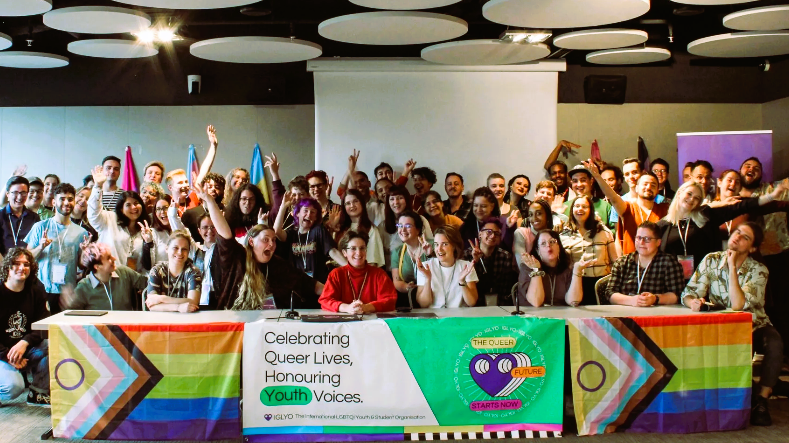
In 2000, the GENDERDOC-M Information Centre was admitted as a full member of IGLYO, the International LGBTQI+ Youth and Student Organisation.
The organization was founded in 1984 and is based in Brussels. IGLYO is the world’s largest network of youth organizations working to protect the rights of LGBTQI+ young people.
Today, it represents the interests of more than 135 member organizations across over 40 countries in the European region. Its work focuses on advocacy, empowerment, and ensuring the freedom of LGBTQI+ young people under the age of 30.
Photo: iglyo.org
The Second Reporting and Election Conference of Moldova’s Gay and Lesbian Civic Movement “Curcubeu/Rainbow”
The second reporting and election conference of Moldova’s gay and lesbian civic movement “Curcubeu/Rainbow” was scheduled to take place on 23 September 2000 at the B. P. Hasdeu Library. However, on the eve of the event, the library director received threats from parishioners, the police, and the Metropolitan Church of Moldova. In particular, it was reported that students from the Theological Academy intended to picket the library. As a result, the conference was moved to the Arts Library.
The event began in the presence of a police officer who was among the invited guests. Twenty minutes later, Chișinău Police Commissioner V. Coval entered the hall and demanded that the conference be stopped, citing an order from “above”. Outside, a minibus carrying police officers was waiting for the participants. The organizers rejected the suggestion that the conference be continued elsewhere, as the commissioner failed to produce any official documents.
The chairman of the movement, A. P. Marcikov, pointed out that the activities of the GENDERDOC-M Information Centre, which defended the rights of gay men and lesbians and fought discrimination based on sexual orientation, were lawful. Under the circumstances, the conference had to be closed and postponed to another date.
GENDERDOC-M informed international human rights organizations about the incident, including the Council of Europe, Amnesty International, Human Rights Watch, the international organization for gay and lesbian rights, as well as foreign embassies accredited in Chișinău. The incident attracted international attention.
The conference eventually took place on 2 December 2000
With financial support from the Soros Foundation Moldova, more than 30 people took part in the conference, including representatives from Bălți and Tiraspol, as well as Florin Buhuceanu, president of the Bucharest-based association ACCEPT.
Participants discussed the continuing discrimination against gay men and lesbians in Moldova, as well as cases of assault, blackmail, threats, and other human rights violations. A decision was taken to establish a public commission within the GenderDoc-M Information Centre to investigate such cases and make the findings public, including at the international level. Plans were also made to employ a lawyer at the Centre to provide legal assistance to members of the LGBT community.
In connection with the establishment of the commission, participants decided to dissolve the “Curcubeu/Rainbow” movement and issued an appeal to the public of the republic. The appeal emphasized: “We do not need propaganda for a sexual revolution. What matters to us is creating an atmosphere in society in which fear ceases to be a determining factor.”
2001
In 2001, Zerkalo became a regularly published magazine. It was not until 2018 that both the magazine and Zerkalo SRL ceased to exist.
In 2001, Zerkalo became a regularly published magazine. It was not until 2018 that both the magazine and Zerkalo SRL ceased to exist.
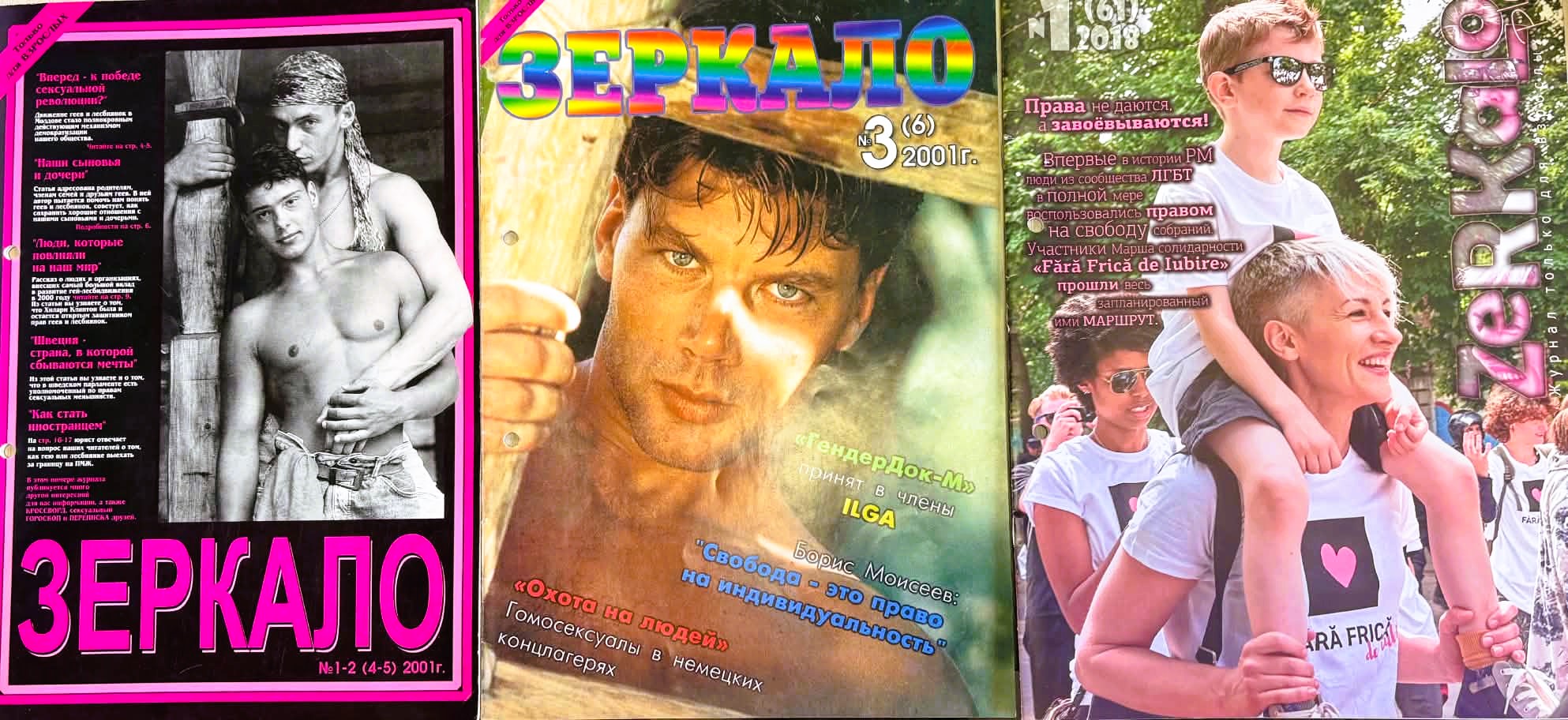
Issue No. 1–2 (4–5) of Zerkalo was published in early 2001 as part of the project “Information Aspects of Homosexuality,” with financial support from the Soros Foundation Moldova. From that point onward, the magazine began appearing regularly, although its publication frequency varied over the years, as did the donors supporting it. The Embassy of the Netherlands in Kyiv made a particularly important contribution to the publication of the magazine.
It is worth noting that when we published issue No. 4–5 and decided to distribute it through retail outlets, we were informed that the magazine first had to undergo a content review by the State Agency for the Protection of Morality, and that information about this review had to be printed in the magazine itself. That is exactly what we did.
When the sixth issue was ready to go to print, the magazine’s editor-in-chief, Alexei Marcicov, went to the State Agency. He was received quite cordially by the women working there. After reading the materials, one of them remarked: “Why do you want to promote homosexuality? Wouldn’t it be better to publish erotic materials and photographs? They would sell much better.”
Mr Marcicov chose not to respond to the suggestions made by the Agency’s employees. He thanked them for their attention, took the typed official opinion and left.
Thus, beginning with issue No. 6, Zerkalo was distributed for sale through the MOLDPRESA and POȘTA MOLDOVEI retail networks. From then on, the third page of every issue carried the following notice: “The materials in this issue have been reviewed by the State Agency for the Protection of Morality.” Anyone who ever looks through the magazine’s bound archive will inevitably notice this line printed at the bottom of page three against a black background.
To illustrate how popular the magazine soon became, we can quote an excerpt from the editorial “Patience, Hard Work and Friends Helped Us Persevere and Find Our Rightful Place in the Sun,” written by Alexei Marcicov to mark the fifth anniversary of the GENDERDOC-M Information Centre and published in issue No. 2 (18) in 2003.
Reflecting on the organisation’s achievements, he could hardly have failed to mention Zerkalo:
“We now publish our own magazine, ‘Zerkalo’, which comes out once every two months. Both its content and its printing quality are admired not only in our country, but far beyond its borders. Gay and lesbian organisations from Moscow and St Petersburg, Saratov, Omsk, Mykolaiv, Kaniv in the Cherkasy Region, Zaporizhzhia, Dnipropetrovsk and Kharkiv, as well as organisations from Belarus, Israel and Kyrgyzstan, ask us to send them ‘Zerkalo’ not in single copies, but in dozens and even hundreds. Unfortunately, we are unable to do so, even though people need the information we publish.”
It was therefore no coincidence that, on 10 November 2008, Military Pub hosted celebrations marking the tenth anniversary of Zerkalo.
The anniversary events had begun several days earlier, on 7 November, at the offices of the GENDERDOC-M Information Centre, where readers called to congratulate the team and express their appreciation for its work. Later, the Centre’s staff gathered for a round-table discussion. They recalled the publication of the first issue, followed by the second and third. Beginning with its fourth issue, however, Zerkalo had become the principal voice and advocate for the initiatives organised by the community and for the community.
Over the course of ten years, 35 issues were published. How should they be described? All other adjectives can be set aside in favour of just two: necessary and important. At least, that is how readers described them. And for any publisher, that is what matters most — that a magazine is valued and in demand.
At the anniversary celebration marking the magazine’s tenth year, editor-in-chief Alexei Marcicov said:
“We understand that the magazine’s frequency and size have suffered, but we can nevertheless take pride in the fact that it is the only publication in the countries of the CIS and the former socialist bloc to have survived for such a long period of time. Perhaps the secret of the magazine’s longevity lies in the affection its readers have for it.”
Following that anniversary celebration, Zerkalo continued to be published for another ten years. In 2018, its final issue — No. 1 (61) — appeared.
Some time later, Alexei Marcicov transferred ownership of Zerkalo SRL to a GDM employee, who subsequently renamed the company and changed its field of activity.
That marked the end of the history of both Zerkalo magazine and Zerkalo SRL.


